
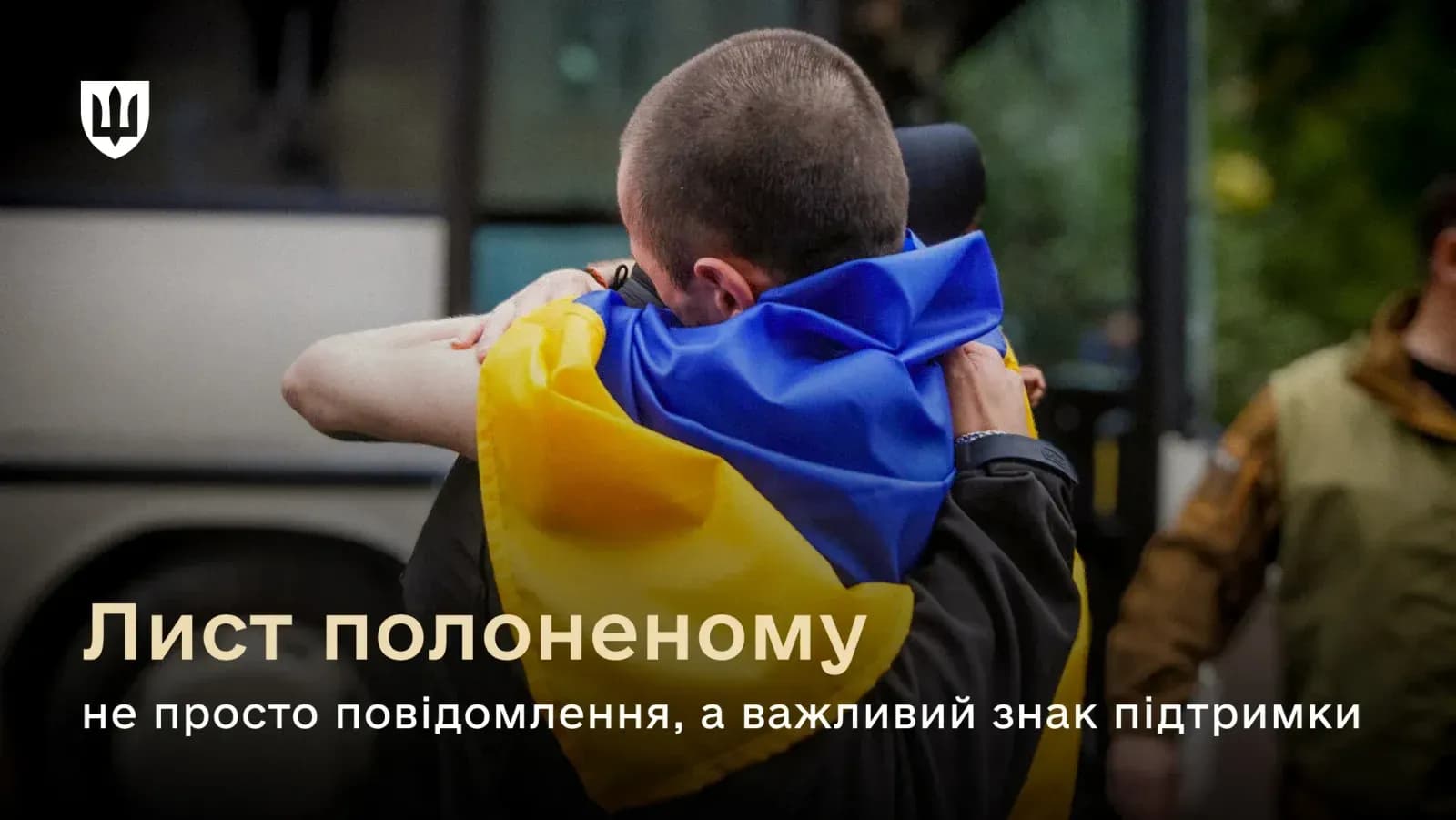
How to write to a Ukrainian defender in captivity
The detaining authorities require letters to be written exclusively in Russian.
Under international law, Ukrainians in captivity have the right to receive letters. Ukrainian institutions work to uphold this right for captured defenders and civilians unlawfully deprived of their liberty as a result of Russia’s armed aggression.
A letter can be an important sign of support. Families can improve the chances of delivery by following the rules for preparing correspondence.
What to leave out
Under the Geneva Conventions, the receiving state may censor and restrict correspondence. The Ministry strongly recommends leaving out:
- Drawings, postcards or other materials that could potentially harm people held in Russian captivity.
- Home addresses, telephone numbers, email addresses or other contact details in the letter.
Write about politically neutral topics, such as family news, and use neutral words of encouragement. The Russian side requires letters to be prepared and written only in Russian. Use clear, legible block letters.
Requirements for letters to Ukrainian defenders in captivity
Read and follow the instructions from the Coordination Headquarters for the Treatment of Prisoners of War, the Ukrainian Parliament Commissioner for Human Rights and the National Information Bureau. The Russian side may return letters that fail to meet the guidelines as undeliverable. In some cases, failure to follow the guidelines can adversely affect the recipient in captivity.
Sending a letter through the Coordination Headquarters
- Use a plain white envelope without stamps, stickers, logos or other identifying marks.
- Write the sender’s full name in the upper-left corner, spelling it out in full.
- In the lower-right corner, write the captive person’s full name. Underneath, write their date of birth in numerals, in day-month-year order.
Put the letter in the envelope and leave it open. You can deliver it to any Coordination Headquarters consultation centre or send it to its public reception office. For postal delivery, put the open inner envelope inside a separate outer envelope addressed according to postal rules.
Public reception office: 37 Spaska Street, Kyiv 04070.
Sending a letter through the Parliament Commissioner for Human Rights
- Use a plain white envelope without stamps, stickers, logos or other identifying marks.
- Write the sender’s full name in the upper-left corner. Underneath, state the sender’s relationship to the captive person.
- Write the captive person’s full name in the lower-right corner. Underneath, write their date of birth in numerals, in day-month-year order.
Leave the inner envelope open. Deliver it in person to the Commissioner’s public reception office or post it inside a separate outer envelope addressed according to postal rules.
Postal recipient: Secretariat of the Ukrainian Parliament Commissioner for Human Rights, 21/8 Instytutska Street, Kyiv 01008.
Sending a letter through the National Information Bureau
Keep the content politically neutral. Leave out comments on military operations or the political situation and anything that could harm the captive person or other Ukrainian service members.
Put the sender’s address only on the outer envelope. On the plain inner envelope, with no stamps or logos, write:
- Upper left: the sender’s full name and relationship to the captive person.
- Lower right: the captive person’s full name and date of birth in numerals, in day-month-year order.
Write both the letter and all details on the inner envelope in Russian. Use either of these delivery options:
- Ukrposhta: Ukrainian National Centre for Peacebuilding, 36-B Yevhena Konovaltsia Street, Building 2A, Kyiv. Mailing is free. Mark the outer envelope «Служба військовополонених».
- Nova Poshta: Branch No. 167, Kyiv. Recipient: Daryna Ruslanivna Ilchuk, phone 096 30 55 760. The recipient pays the delivery charge.
Failure to follow the instructions may lead the Russian side to refuse delivery. Even a correctly prepared letter may go undelivered. Delivery depends on whether the Russian side complies with international humanitarian law.
Ukrainian institutions and the International Committee of the Red Cross continue working to help Ukrainian defenders and civilians in Russian captivity receive news from their families. Even a few lines of support can remind someone in captivity that people are waiting for them and still working to bring them home.
The Ministry of Defence previously explained how the personal account on the Coordination Headquarters website helps speed up the return of defenders from captivity.
English translation of the Ministry of Defence of Ukraine original · CC BY 4.0.